
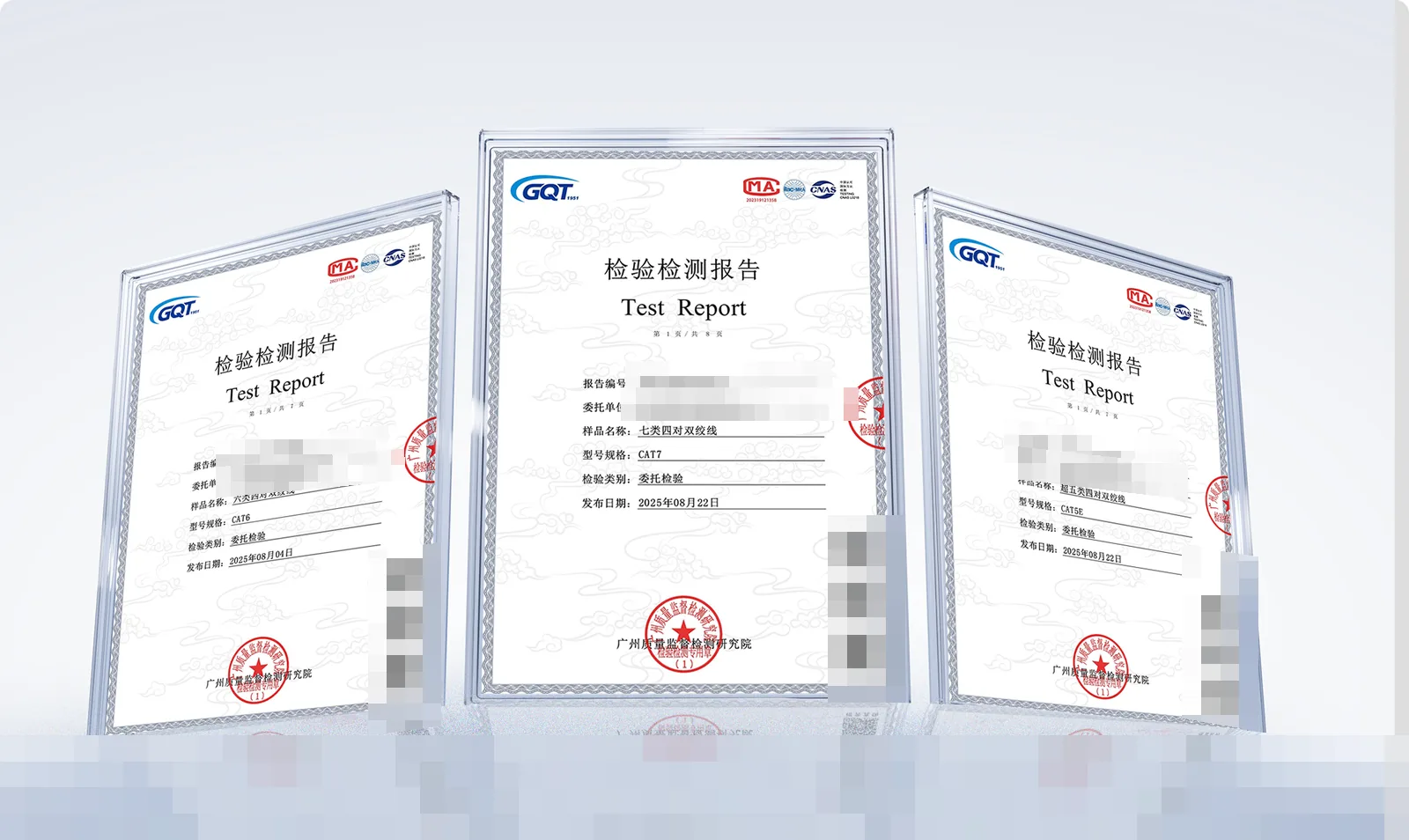
Start with the complete buying decision
Each document answers a different question. CE marking is the manufacturer's declaration of conformity with applicable EU directives for products placed on the EU market. RoHS restricts hazardous substances. ISO 9001 certifies the supplier's quality-management system, not a specific product. A Fluke report is a field or factory performance test of a specific link. Always confirm the issuer, product scope and validity before relying on any one of them.
1. CE marking — conformity for the EU market
CE marking indicates that a product complies with the applicable EU directives (for cable, typically EMC and, where relevant, Low Voltage). The European Commission notes CE marking is affixed by the manufacturer as a self-declaration supported by the required assessment; it is product- and directive-specific, not a blanket quality stamp.
2. RoHS — restricting hazardous substances
The EU RoHS Directive restricts specific hazardous substances (such as lead and certain phthalates) in electrical and electronic equipment. A RoHS declaration addresses material composition; it does not describe electrical performance or quality-system maturity.
3. ISO 9001 — a quality system, not a product
ISO 9001 certifies that the supplier operates a quality-management system to an international standard. It is evidence about how the organisation controls its processes — useful for supplier due diligence — but it is not a test of any individual cable, so it should be read alongside product-level evidence.
4. Fluke reports — testing a specific link
A Fluke test report certifies that a specific cable link meets a named category limit (for example a permanent-link or channel test). It is the most product-specific evidence for LAN cable, but the report is only valid for the stated limit, adapter and link — so the acceptance scope must be named in the RFQ.
Fluke Networks distinguishes cable type from test limit, and warns that the chosen limit and adapter must match the installed link for the certification to be valid.
5. Verify scope before you rely on a document
A certificate held by a supplier does not automatically apply to every product or shipment. Confirm the issuing entity, the exact model or construction covered, the standard, and the validity date, and match the document set to your destination market's import requirements.
- Issuing entity and accreditation
- Exact product or construction in scope
- Standard and version referenced
- Validity date and current status
- Destination-market import requirement
Procurement checklist
- 01Destination market and its import requirements
- 02Which directive or standard applies to the product
- 03CE scope (which directives) if EU-bound
- 04RoHS declaration where required
- 05Supplier ISO 9001 certificate and validity
- 06Product-level test evidence (e.g. Fluke for LAN)
- 07Issuer, model scope and validity of each document
- 08Whether the document matches the exact construction ordered
Common mistakes
- Treating ISO 9001 as proof of a specific product's performance
- Assuming CE covers quality rather than directive conformity
- Accepting a Fluke report without a named test limit
- Reusing a certificate for a different construction or model
- Ignoring the destination market's own import requirements
Questions buyers ask next
Does ISO 9001 mean the cable itself is certified?
No. ISO 9001 certifies the supplier's quality-management system, not an individual product. Read it alongside product-level test evidence.
Technical source: International Organization for StandardizationIs CE marking a quality guarantee?
No. CE marking is the manufacturer's declaration of conformity with applicable EU directives for the EU market — it is directive-specific, not a general quality mark.
Technical source: European Commission (Your Europe)Why must a Fluke test name its limit?
Because the limit and adapter define how the link is evaluated; a cable-type setting alone does not make a valid certification test.
Technical source: Fluke NetworksSources & further reading
Official material used for the factual statements on this page.
- European Commission (Your Europe)CE marking — obtaining the marking
- European CommissionRestriction of Hazardous Substances (RoHS) Directive
- International Organization for StandardizationISO 9001 — Quality management systems
- Fluke NetworksChoosing the Test Limit – DSX CableAnalyzer