
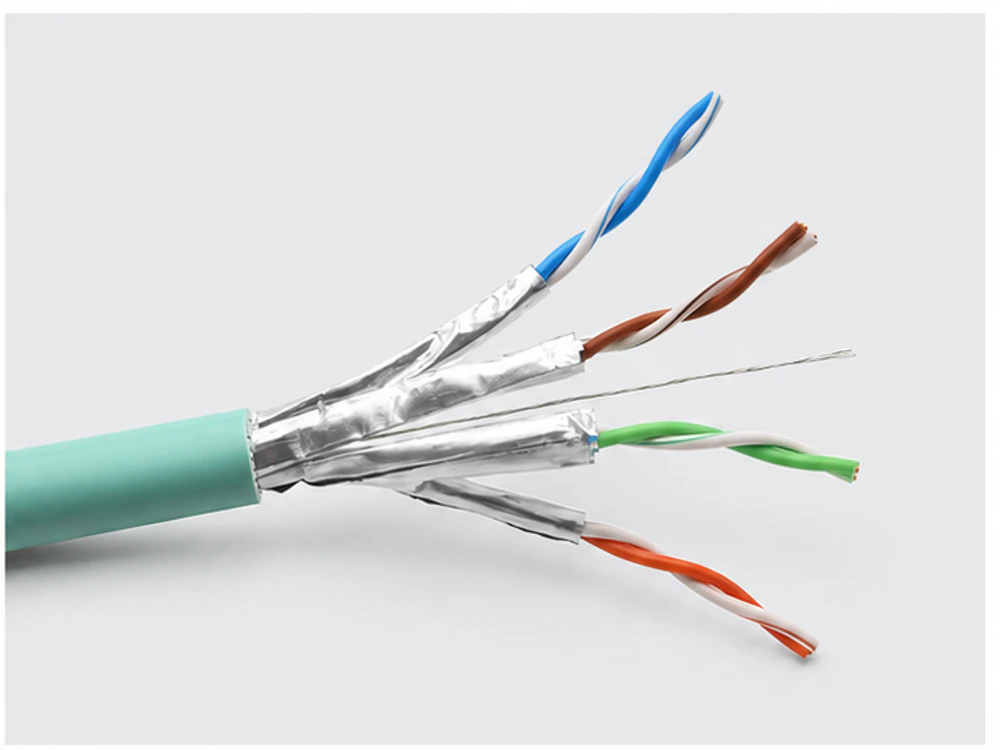
Start with the complete buying decision
UTP is unshielded and suits most standard indoor installations. FTP (foil) adds an overall foil shield for moderate interference. S/FTP adds a braided shield around foil-screened pairs for the highest interference rejection. Shielding only works when the shield is bonded and grounded end to end, so it must be chosen as part of a designed, grounded system — not added as an isolated cable upgrade.
1. What each construction means
The letters describe where the screening is. UTP has no shield. FTP (also written F/UTP) has an overall foil around all pairs. S/FTP has an overall braid plus individual foil screens on each pair, giving the strongest protection against both external interference and crosstalk between pairs.
| Construction | Shielding | Typical use |
|---|---|---|
| UTP | None | Standard indoor office and home runs |
| FTP / F/UTP | Overall foil | Moderate EMI, industrial-adjacent runs |
| S/FTP | Braid + per-pair foil | High EMI, data centers, long parallel runs |
2. When shielding is worth it
Choose shielding from the electromagnetic environment: proximity to power cable, motors, or other noise sources; long parallel bundles; and the project's standard. In a clean indoor environment, UTP is usually sufficient and easier to install.
3. Shielding only works when grounded
A shield that is not bonded and grounded end to end can perform worse than UTP by acting as an antenna. Shielded systems require compatible shielded connectors, correct bonding and a defined grounding responsibility, so shielding is a system decision, not a cable-only decision.
- Shielded cable + shielded connectors + patch panels
- Bonding at the defined points
- Grounding responsibility named in the project
- Pathway and equipment earthing conditions
4. Specify it as a complete link
State the construction (UTP, FTP or S/FTP), the category, the connector and the grounding plan together. Matching the shielded cable with the wrong connectors, or leaving grounding undefined, undermines the benefit you paid for.
Procurement checklist
- 01Electromagnetic environment of each run
- 02Parallel-power and bundle conditions
- 03Construction (UTP / FTP / S/FTP) per link group
- 04Matching shielded connectors and panels
- 05Grounding and bonding responsibility
- 06Category and test limit
Common mistakes
- Adding shielded cable without shielded connectors
- Leaving the shield ungrounded
- Using S/FTP everywhere 'to be safe' and inflating cost
- Choosing shielding without an EMI reason
- Not naming grounding responsibility in the project
Questions buyers ask next
Is shielded cable always better?
No. Shielding only helps when there is an interference reason and the shield is bonded and grounded end to end. In clean indoor environments UTP is usually the better, easier choice.
Can I use shielded cable with unshielded connectors?
No — the shield must be continuous through compatible shielded connectors and panels, or the benefit is lost. Match the whole channel.
Sources & further reading
Official material used for the factual statements on this page.
- Fluke NetworksChoosing the Test Limit – DSX CableAnalyzer